AI-Proofing Your Degree: How to Master “Human-First” Essay Writing in 2026
The academic landscape has shifted. In 2026, the “AI-detector” arms race has reached a boiling point, leaving many undergraduate students feeling like they are walking on eggshells. The fear isn’t just about being accused of academic dishonesty; it’s about losing the unique, human spark that makes an essay truly stand out. If everyone is using the same algorithms to generate ideas, the value of a degree starts to plummet. To stay ahead, students must pivot toward a “human-first” approach that prioritizes critical thinking, personal voice, and lived experience.
The journey to an original paper starts long before you open a blank document. It begins with the freedom to explore ideas that don’t feel like a chore. One of the best ways to warm up your “creative muscles” is to step away from rigid academic prompts for a moment. Engaging with various informal essay topics allows you to practice writing with a natural, conversational flow. When you write about something personal or lighthearted, you find your unique rhythm. This “voice” is exactly what professors are looking for—it is the one thing AI cannot convincingly replicate.
Why “Human-First” Writing is the New Gold Standard
In today’s digital-heavy environment, university tutors are no longer impressed by perfectly polished, generic prose. They are looking for “E-E-A-T”—Experience, Expertise, Authoritativeness, and Trustworthiness. A human writer can connect two unrelated concepts through a personal anecdote or a local cultural reference. AI, on the other hand, usually sticks to the most statistically likely word patterns.
The Evolution of Academic Integrity
| Feature | AI-Generated Content | Human-First Writing |
| Tone | Uniform, repetitive, and clinical | Varied, rhythmic, and emotive |
| Evidence | Often “hallucinated” or outdated | Primary sources and current data |
| Critical Thinking | Summarizes existing views | Challenges existing views |
| Connection | Transactional information | Relatable human experience |
Moving Beyond the “Prompt” Culture
The biggest mistake students make in 2026 is treating their essay instructions like an AI prompt. If you ask a machine to “write a 1,000-word essay on climate change,” you get a 1,000-word block of digital noise. To write like a human, you need to engage in “Deep Research.” This means visiting libraries, interviewing experts, or even participating in online forums to see how real people are discussing a topic.
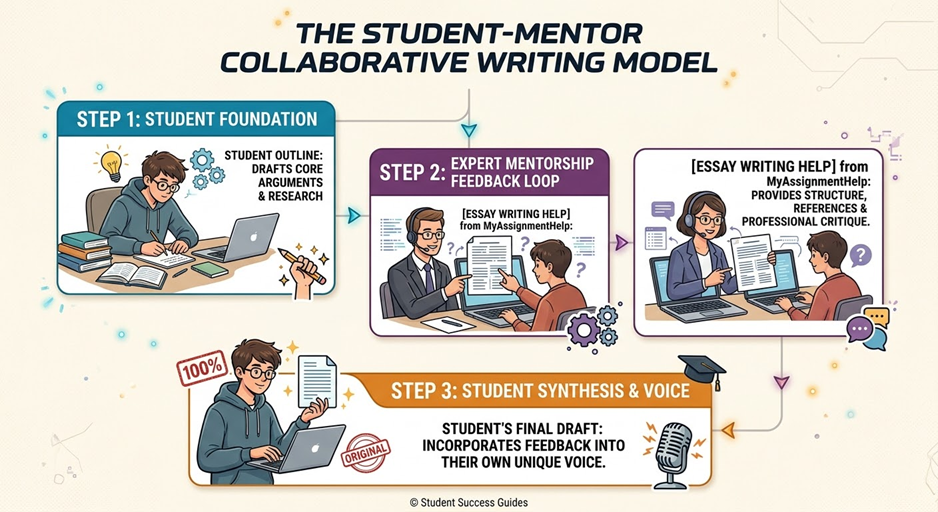
Sometimes, the complexity of these high-level modules can be overwhelming. Whether it’s a difficult nursing case study or a dense legal analysis, getting stuck is a natural part of the learning process. In these moments, seeking professional essay writing help from a reliable platform like MyAssignmentHelp can be a strategic move. Rather than using it to bypass the work, think of it as a collaborative mentorship. Seeing how an expert structures a complex argument provides a roadmap that you can then adapt into your own voice, ensuring you meet academic standards while maintaining your integrity.
4 Strategies to Humanize Your Academic Work
1. The “Coffee Shop” Test
After writing a paragraph, read it out loud. If it sounds like something you would never say to a friend over coffee, it’s probably too “robotic.” Human writing has imperfections, varied sentence lengths, and occasional rhetorical questions. If your text is too perfect, it loses its soul.
2. Prioritize Primary Sources
AI models are trained on data that is often several months or years old. To rank your thoughts (and your paper) higher, use “Live Data.” Reference a news event from this morning, a recent tweet from a world leader, or a fresh study released this week. This proves to your tutor that you are actively engaged with the world.
3. Use Visual Mind-Mapping
Before you type a single word, draw your ideas. Visualizing the connections between concepts prevents you from following the linear, predictable path that AI usually takes.
4. Inject “Personal Experience” (The Reflection Hook)
Even in a formal scientific paper, there is often room for a reflective conclusion or an introduction that explains why the research matters. Connecting a global issue to a local community problem shows a level of synthesis that software simply hasn’t mastered yet.
Managing the 2026 Workload Without Losing Your Voice
The modern student isn’t just a student; they are often a freelancer, a content creator, or a part-time employee. The “Burnout Era” is real. To succeed, you must manage your time by focusing on the thinking phase of your essay. If you spend 70% of your time brainstorming and only 30% typing, your quality will skyrocket.
When the deadline is looming and the pressure is high, don’t let the stress force you into using “shortcut” tools that trigger red flags. The key is to stay organized and use legitimate academic support systems that focus on tutoring and structural guidance.
Conclusion: The Future belongs to the Original Thinkers
As we move further into 2026, the value of a degree won’t be measured by the ability to compile information—machines can do that in seconds. It will be measured by the ability to argue, to empathize, and to innovate. By adopting a “human-first” mindset, using diverse writing prompts for practice, and knowing when to seek expert structural guidance, you aren’t just passing a class. You are future-proofing your career in an increasingly automated world.
FAQs: Navigating the New Era of Writing
Q: Will using a professional service trigger AI detectors?
A: Not if you use it correctly. Services like MyAssignmentHelp provide original, human-written research and drafts. When you use these as a study guide to write your own final version, the result is an authentic, human-led piece of work.
Q: How can I make my writing sound more “Gen Z” without being unprofessional?
A: It’s not about using slang. It’s about being direct and transparent. Avoid “fluff” words like furthermore or moreover if they don’t feel natural. Use clear, impactful language.
Q: Do professors really check for “human” voice?
A: Yes. Most universities now use sophisticated tools that look for “burstiness” (variation in sentence length) and “perplexity” (unpredictability). If your essay is too predictable, it raises a flag.
Q: Can informal writing actually help my GPA?
A: Absolutely. Practicing with casual prompts helps you overcome writer’s block and builds confidence, which eventually translates into more fluid and persuasive formal essays.
About The Author
Hi there! I’m Ruby Walker, and I’ve spent the better part of the last decade navigating the ever-evolving world of digital education and academic strategy. As a senior consultant and lead content strategist at MyAssignmentHelp, my mission is to empower students to find their own unique voice in an increasingly automated world.