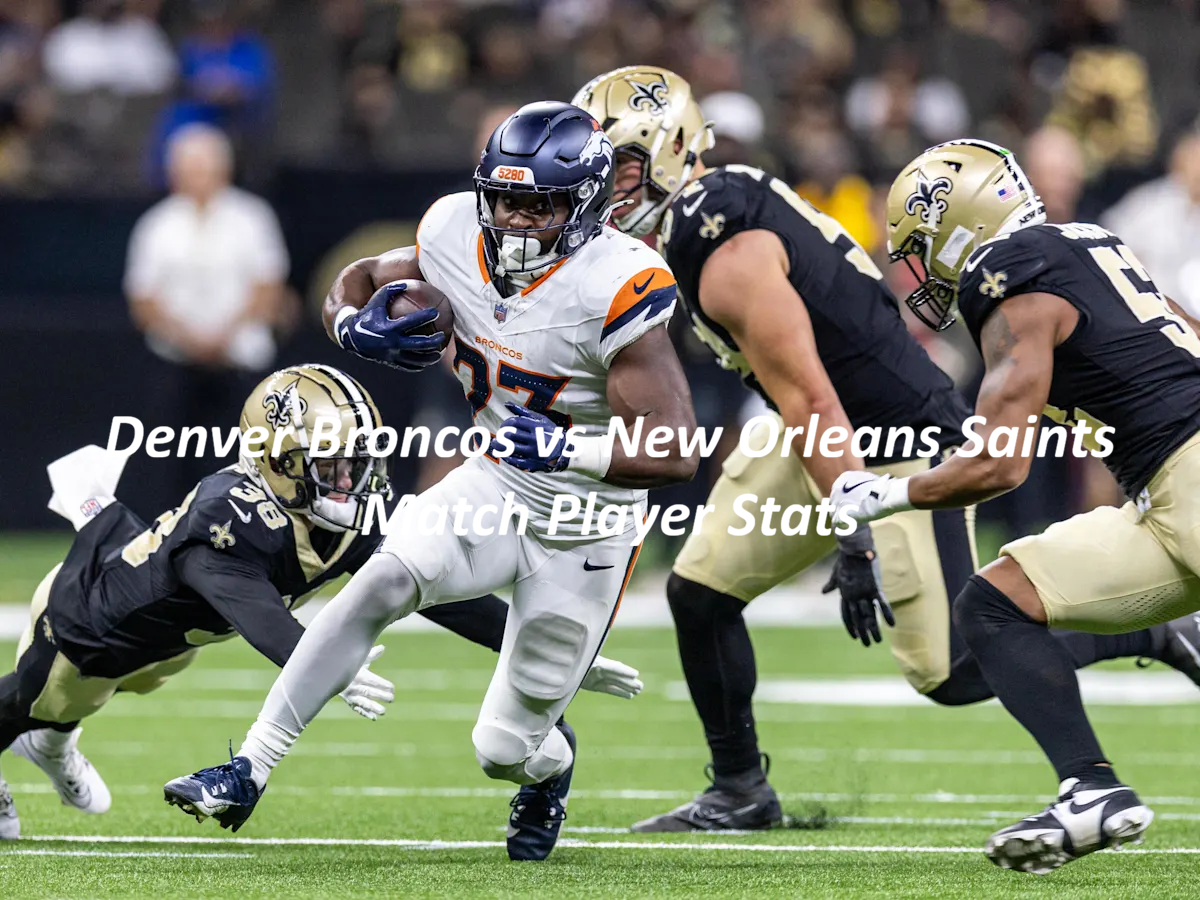
Denver Broncos vs New Orleans Saints Match Player Stats: Complete Game Breakdown
The Denver Broncos vs New Orleans Saints match player stats tell a very clear story of control, execution, and momentum. When these two teams met, the final scoreline reflected far more than just points on the board—it highlighted efficiency, discipline, and impact performances across offense, defense, and special teams. This article takes a clean, detailed, and expert-level look at the player statistics from the matchup, breaking everything down in a way that’s easy to understand while still offering real football insight.
Instead of simply listing numbers, we’ll explain what those stats meant, how individual performances shaped the game, and why Denver walked away comfortably ahead while New Orleans struggled to keep pace.
Overall Match Overview and Statistical Context
From kickoff to the final whistle, the Broncos dictated the rhythm of the game. They played smart football, avoided major mistakes, and capitalized on nearly every opportunity. Statistically, Denver dominated total yards, rushing efficiency, and defensive impact, which ultimately separated them from the Saints.
Denver finished the game with nearly 400 total offensive yards, while New Orleans failed to cross the 300-yard mark. More importantly, the Broncos consistently won the battle in the trenches. Their offensive line opened running lanes, their defense disrupted timing, and their special teams added valuable points whenever the offense stalled.
The Saints, on the other hand, showed flashes of potential but lacked consistency. Drives often ended without points, and defensive breakdowns allowed Denver to build momentum early and never let go. The player stats reflect a team that fought hard but struggled to execute in key moments.
Denver Broncos Offensive Player Stats Breakdown
Denver’s offense didn’t rely on explosive passing numbers. Instead, it focused on balance, patience, and smart decision-making. This approach is clearly visible in the individual player stats.
Quarterback Performance: Bo Nix
Bo Nix played the role of a composed field general rather than a stat-padding quarterback. He completed the majority of his passes, avoided turnovers, and kept the offense on schedule throughout the game.
Nix finished with over 160 passing yards on efficient completions, but his biggest impact came with his legs. He rushed for more than 70 yards, repeatedly extending drives and forcing the Saints’ defense to respect his mobility. His rushing ability opened up the run game and kept linebackers guessing.
While he didn’t throw a touchdown pass, his calm presence and situational awareness were key reasons Denver stayed in control. This was a performance that won games, even if it didn’t dominate highlight reels.
Running Game Dominance: Javonte Williams
Javonte Williams was the clear offensive star for Denver. He carried the ball with authority, consistently gaining yards after contact and wearing down the Saints’ defensive front.
Williams rushed for nearly 90 yards and scored two rushing touchdowns, both coming in crucial red-zone moments. His vision and patience allowed him to find gaps, while his physical running style made him difficult to bring down on first contact.
In addition to his rushing success, Williams contributed in the passing game, adding valuable receiving yards that helped sustain long drives. His all-around performance perfectly embodied Denver’s balanced offensive philosophy.
Receiving Contributions and Supporting Cast
Denver Broncos vs New Orleans Saints Match Player Stats receiving group didn’t rely on one superstar performance. Instead, multiple players contributed steady production throughout the game.
Wide receivers and tight ends combined for consistent short-to-medium gains, moving the chains and keeping the offense fluid. Several receivers finished with 40–50 receiving yards, showing strong route discipline and reliable hands.
This type of distribution made it difficult for the Saints’ defense to lock in on a single target, allowing Denver to control tempo and possession without forcing risky throws downfield.
New Orleans Saints Offensive Player Stats Breakdown
While Denver’s offense flowed smoothly, the Saints’ offensive numbers reflected inconsistency and missed opportunities.
Quarterback Play and Passing Efficiency
New Orleans rotated quarterbacks during the game, which often disrupted offensive rhythm. The primary quarterback completed a high number of passes and surpassed 170 passing yards, but those completions rarely turned into explosive plays.
Most passes came underneath coverage, resulting in short gains that failed to flip field position. Although the completion rate looked solid on paper, the lack of touchdowns and red-zone efficiency told a different story.
A secondary quarterback added a late touchdown pass, but by that point, the game was already heavily tilted in Denver’s favor.
Rushing Struggles and Lack of Balance
The Saints’ rushing attack never found traction. Their leading rushers combined for under 50 rushing yards, forcing the offense into predictable passing situations.
Without a consistent ground game, Denver’s defense was able to apply pressure and focus on limiting passing lanes. This imbalance made it extremely difficult for New Orleans to mount sustained scoring drives.
Even talented backs struggled to gain momentum, as defensive penetration and missed blocking assignments repeatedly shut down running lanes.
Receiving Leaders and Offensive Highlights
Despite the overall struggles, a few Saints receivers delivered respectable individual performances. One receiver led the team with over 50 receiving yards and a touchdown, providing a rare bright spot in the offense.
Another receiver added solid yardage through short receptions, but overall, the passing game lacked explosive downfield plays. Denver’s secondary stayed disciplined, limiting yards after catch and preventing big momentum swings.
Denver Broncos Defensive Player Stats and Impact
If there was a true game-changing unit on the field, it was Denver’s defense. Their statistical impact went beyond tackles and sacks—it directly produced points.
Turnovers and Defensive Touchdown
Denver’s defense forced multiple turnovers, including critical fumbles that completely shifted momentum. One of those turnovers was returned for a long defensive touchdown, instantly energizing the team and crowd.
These plays not only added points but also crushed New Orleans’ confidence. Defensive scores are rare, and when they happen, they often decide games—this was no exception.
Tackles, Pressure, and Discipline
Linebackers and defensive backs were active throughout the game, combining for double-digit tackles and several tackles for loss. Defensive pressure limited the Saints’ ability to develop plays, forcing quick throws and disrupted timing.
Denver’s defense also showed strong discipline, avoiding unnecessary penalties and maintaining tight coverage across all levels. This allowed them to control the Saints’ offense without relying solely on blitzes.
Special Teams Player Stats and Hidden Value
Special teams played a quiet but critical role in Denver’s victory. Their kicker delivered a perfect performance, converting every field goal attempt, including a long-distance kick from beyond 50 yards.
Those points mattered. Every successful kick extended Denver’s lead and eliminated any chance for the Saints to regain momentum. Consistent special teams execution often goes unnoticed, but it was a major factor in the final scoreline.
What the Player Stats Really Tell Us
When analyzing the Denver Broncos vs New Orleans Saints match player stats, one conclusion stands out: Denver played complementary football at a high level. The offense controlled the ball, the defense created scoring opportunities, and special teams capitalized whenever needed.
New Orleans showed effort and occasional flashes of talent, but inconsistency across multiple units prevented them from competing deep into the game. Stats don’t just show numbers—they reflect preparation, execution, and adaptability.
Final Thoughts
This matchup serves as a textbook example of how games are won in the NFL. Denver didn’t rely on flashy passing totals or highlight-heavy performances. Instead, they trusted their system, executed fundamentals, and let player stats tell the story of a complete team effort.
For fans, analysts, and fantasy football enthusiasts alike, this game offered valuable insight into how balanced production and disciplined play can overwhelm even talented opponents. The numbers don’t lie—and in this case, they clearly favor the Denver Broncos.